
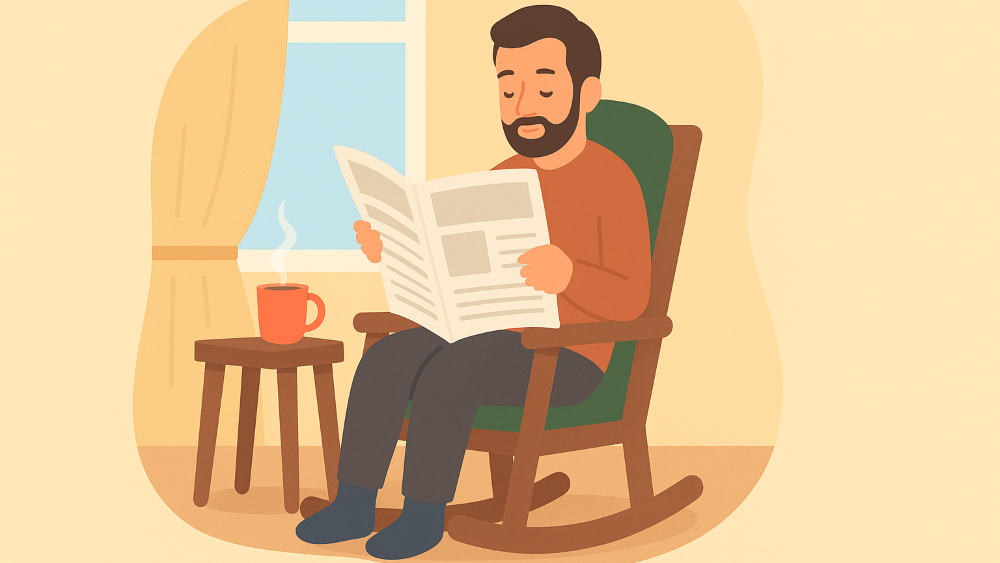
Sameer always has that one chair. The one in the corner, next to a window, tucked away and out of the way. It wasn’t the fanciest chair or the most cushioned. But it was his chair. After work, he would sink into that chair with a chai in hand, one slipper always riding halfway off, and he would always sit in silence. Sometimes without thinking, he would scroll through his phone; other times, he would look into the world outside. Sameer’s friend, Megh would stop by, and they would speak. Not speak about feelings, and never directly. Between the subjects of the cricket match score, car repair thoughts, and the newest office gossip, there was something else being shared. Something quieter, but just as important.
This– this– was Sameer’s safe space.
We talk a lot about mental health, therapy, journaling, vulnerability– and rightly so. But what can often get lost in the conversation is the acknowledgement that not everyone expresses and processes emotion in the same way. Especially men, who have been told, directly or indirectly, that strength and silence go hand in hand. That vulnerability is a weakness. That emotions are private matters, to be “dealt with” alone.
And yet, men do process. They do feel. They do cope.
Just… differently.
A gym turns into more than a place to workout. It becomes a battleground where each rep is a reprieve from stress.
A group of friends sitting together and making fun of each other, affectionately– it’s bonding in the most natural form.
The corner of a balcony where a man sits with his morning tea, reading the newspaper, might be the only moment of peace in his day.
These are some of the modern day equivalent of tribal circles and community fires. They’re safe spaces, rituals and releases, even if they are never named as such.
WHY SAFE SPACES MATTER
Most men don’t text their friends, “I need to talk.”
They may not acknowledge that something is “off”. But give them a space where they feel accepted, where they don’t have to perform, and you will often see the weight start to lift.
These spaces are important because:
- Offer non-verbal ways for men to let out emotions.
- Normalize the emotional presence without pressure.
- Reassure belonging with no judgement.
- Encourage vulnerability in disguise
They may never say, “I feel anxious,” but they will show up for a football match after an incredibly tiring day. They may not post they’re burnt out, but they will spend the extra hour at the gym just to “clear their head.” These behaviours aren’t escapes, they are quiet forms of self-preservation.
It would be a good idea to stop dismissing these behaviours as “just habits” or “distractions.”
They are often the most authentic ways for some men to show up for themselves.
CREATING (OR RECOGNIZING) SAFE SPACES
One can create such a safe space– or realize if there exists one already. Here is how:
- Be aware of where you feel like yourself:
Maybe it is your music playlist or your body feeling relaxed as you physically fix something with your hands. These are your signs.
- It doesn’t have to be emotional for it to be healing:
A safe space is not necessarily an emotional space. It can be about doing something that centers you. Playing, walking, lifting, building– all can be powerful emotional anchors.
- Keep it consistent:
Routines create safety. Finding a time or a ritual that you regularly go back to– a hike, a game night or a daily jog– is the easiest way to find your space.
- Find or build a tribe:
Surrounding yourself with people who let you exist as you are is key. It’s people who won’t pressure you to talk, but will listen if you ever choose to.
TO ALL MEN OUT THERE
Maybe you don’t have the words to express yourself. Maybe you have never been asked how you’re really doing. Perhaps the very thought of therapy feels distant– or simply not meant for you. And that’s okay!
You are allowed to comfort yourself.
You are allowed to need space, rest, sweat, movement, sound, or silence.
You are allowed to create a corner of the world where you do not have to wear any masks.
Your safe space doesn’t have to resemble anyone else’s. It’s your center. Maybe we can also say that on a map of your life, its coordinates would be (0,0)! It simply needs to feel like YOU.
So here is to the barbershop chair, the sagging couch, the boxing bag, the football field, the chai thela, the bike ride, the midnight walk– here is to the spaces that silently hold men when they do not have the words to ask for help or company.
You may not call it therapy. It may not be too obvious.
But if it helps you breathe a little easier, then it is healing!