
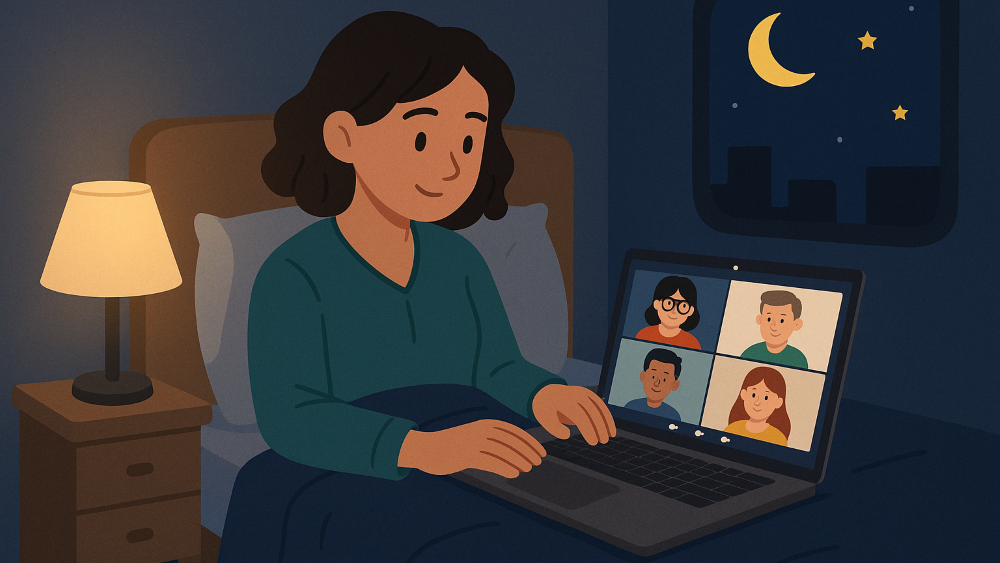
Remote working has changed the workplace as we know it. It was once something for a small group of people like freelancers, people in tech and that was about it. Now, almost every occupation allows employees to work remotely. Like so many things, COVID-19 is largely responsible for altering work patterns and the workplace, often into something that people like better than the “traditional workplace”. Companies adapted quickly, surprisingly quickly, and many found that remote working created benefits that workers, and companies, were happy with. But, remote work is becoming more permanent, and as such, we need to take a close look at its positives and negatives and the effects of remote working and on mental health, and boundaries in work and personal life.
PROS AND CONS OF REMOTE WORK
- Boundaries:
For a lot of people it is easier to say no, to maintain boundaries when you don’t see a person day in, day out. They log out on time and if they log in some extra work, it’s documented by the same systems that make sure they are working the required amount of time.
But while flexibility is an awesome perk, it can also be a double-edged sword. Remote worker burnout rates are incredibly high, mainly because they struggle to “switch off” after hours. Without the physical separation of an office space, the lines defining the work and home balance are often blurred.
- Social Battery:
There is a certain amount of choice in remote work that can make socialization easier. There is a choice in logging in and posting something on the Slack, in asking someone to be on the Zoom call. It isn’t compulsory in the same way and so people can appreciate it a bit more. After all, it’s much easier to like a colleague when you know you don’t need to nod at the right moments and interject with the perfect words when they’re talking.
However, humans are inherently social beings. Loneliness and disconnection may arise when working remotely. Lacking a regular in-person team experience can bring distance and disconnect from teammates. This distance can be detrimental to both mental health and overall morale.
- Productivity:
In contrast to the previous worries about productivity cuts, many employers found that remote employees were even more productive. Working professionals were able to eliminate significant distractions that occur while in a workplace, and with the significant autonomy often gained by remote workers, employees were able to more efficiently and effectively complete their work. People are also a lot more productive and energetic about work when they haven’t just gotten into office after a two hour commute that drains them of all the zest a night’s sleep gives them.
But productivity can also be reduced because of the natural constraint in communication. Remote communication relies on a broader reliance on written messages or scheduled calls, and one aspect that is impossible to duplicate is being able to read body language or the immediate questioning and clarification that are possible in-person. As remote collaboration is limited to screens, it often appears to be forced and lacking in collaborative creativity (e.g. brainstorming). In hybrid teams, remote individuals may feel marginalized in the decision-making process when in-person members seem to have more control over a meeting.
- Resources:
Remote work has allowed employers to break down geographic barriers. For hiring and employment, this is a great thing for companies because it allows companies to hire from a larger pool of talent. Removing barriers leads to more diversity, and allows people with differing cultural, educational, and economic perspectives the opportunities to join the workforce. Remote work also makes it easier for individuals with physical disabilities, chronic health issues, or mental health issues to work from a comfortable space.
But not all employees have equal remote work experience. Different working situations arise due to differing levels of internet speed, amount of personal space in the home (e.g. whether or not a spouse or other family is sharing the space), or something as basic as access to an ergonomic workstation create a lot of variability in everyone’s work experience. Although these situations may impact performance and health, sometimes we overlook our access to resources. Additionally, even if remote workers have provided valuable contributions to the team decisions, the lack of visibility may lead to biased evaluations when a virtual teammate is perceived as less engaged than their in-the-office fellow team members.
MENTAL HEALTH AND REMOTE WORK
Psychologically, the advantage of remote work is that it can alleviate the strain of commuting and allow for some distance from the harmful politics associated with the office, but at the same time, it can create stressors like digital fatigue, less social support, and overworking. Hence, mental health professionals stress the importance of following a routine, creating clear boundaries, and building a virtual community to make remote work viable in the long-term.
In practical terms, recreating structure can be accomplished by:
- creating a fixed work schedule, work space,
- using time-tracking applications.
- employers can be impactful by providing virtual wellness programs,
- reasonable time allotted to work on projects,
- honoring employees’ “camera-off time” to provide relief from screen fatigue.
CONCLUSION
Remote work is not a one size fits all, it’s not a solution that works for every organization—it’s a framework that demands careful planning, flexibility, and empathy. For some employees, remote work is a dream realized, and for others, it’s a source of additional stress. The future of work likely resides in some form of hybrid model, capturing the best of both worlds—providing flexibility while fostering a sense of connection and inclusivity.
Organizations must also recognize the human element. It is not just about productivity; it is about being intentional and designing systems that contribute to emotional, social, and physiological well-being, equity, and authentic collaboration. For individuals, self-awareness and reflective practices (like white-boarding or mind mapping), balancing autonomy with structure, and finding ways to stay meaningfully connected are key.
Fortunately or unfortunately, remote work is neither a short-term, nor a temporary trend—it is here to stay! It’s up to us, as empathetic individuals, to do it the right way!